Move beyond good intentions.
Build consistent protection across your campuses.
United Educators (UE) has partnered with Praesidium to offer members preferred pricing on Praesidium Accreditation.
Accreditation isn't a check box - it's a catalyst for change that demonstrates to your organization, your consumers, and your community that you have a commitment to create a culture of safety.
Whether you’re managing a K-12 school, district, or higher education institution, the challenge is the same: ensuring prevention practices are applied consistently across diverse environments.
Praesidium Accreditation is a structured, research-informed process that helps K-12 schools and higher education institutions embed abuse prevention into systems, culture, and daily operation. Not just policies.
Praesidium is a team of researchers, attorneys, social workers, human resource professionals, and other industry experts dedicated to creating safer environments for vulnerable populations. We’ve partnered with thousands of organizations across youth services, education, healthcare, religious ministries, insurance carriers, and more to develop sustainable abuse prevention strategies that withstand real-world challenges. As the national leader in abuse risk management, Praesidium helps organizations prevent sexual abuse and protect the vulnerable populations they serve.
Why Educational Institutions Are Re-Evaluating Prevention
Schools today are expected not just to respond to incidents, but to demonstrate what they are doing to prevent them.
Rising Expectations Around Abuse Prevention
Increased Scrutiny from Boards, Families, Insurers, and Regulators
Pressure to Show that Prevention is Intentional and Operationalized
Over 330 Accredited Organizations Across Multiple Industries
Consistency Matters More Than Intent
Most schools already have strong intentions, policies, and training in place. But in decentralized environments, those safeguards often operate in silos.
Practices can vary across departments, program environments, and campuses
Supervision and expectations differ by program
Warning signs may be missed due to inconsistency
Risk increases when safeguards don't work together. Praesidium Accreditation provides the system and structure to ensure consistency in your abuse prevention practices, even across a highly siloed organizational structure.
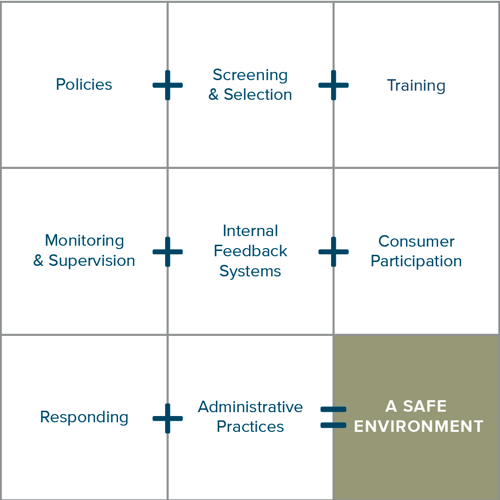
Praesidium Accreditation is built on the Praesidium Safety Equation®. This proven prevention model is grounded in research, case analysis, and decades of experience working with schools, higher education institutions, and other organizations serving youth and vulnerable populations.
Rather than relying on a single safeguard, the Safety Equation recognizes that abuse occurs when systems are weak, inconsistent, or disconnected. This is true across K-12 schools, colleges, and universities alike, where prevention efforts often vary across classrooms, campuses, and programs.
True prevention happens when policies, screening, training, supervision, reporting, and leadership accountability work together. Weakness in one area increases risk everywhere else.
Accreditation provides structure, helping you move beyond intention to build prevention practices that are aligned, consistent, and sustainable across your entire organization.
In 2024, Praesidium surveyed Insurance Carriers to gain insight into how they are adapting to a changing risk landscape regarding Sexual Abuse & Molestation Liability (SML) coverage. This benchmarking report examined evolving underwriting expectations, market trends, and loss control measures.
As part of that survey, Praesidium asked carriers, "If an outside expert publicly accredited an organization as meeting or exceeding best practices in abuse prevention, would that status positively impact their ability to access SML coverage?" 94% respondedYES.
Additionally:
53% are more likely to offer lower premiums
60% are more likely to offer higher limits
93% are more likely to offer coverage at all
This shows that underwriters view Praesidium Accreditation as a clear sign of commitment, a third-party validation, and a signal that exceeds industry standards.
Learn What it Takes to Become Praesidium Accredited
Days
Hours
Minutes
Seconds
Join us for a 60-minute webinar on:
September 10th at 2:00 p.m. (CST)
Many organizational leaders support the idea of accreditation but hesitate to decide whether the time is right. Questions arise about organizational readiness, leadership capacity, and return on effort. Questions that are not only common but also necessary.
This session, presented by Praesidium experts Jamie Fray Mills and Brandie Le Clair, will help you answer the question, "Is our organization ready for Praesidium Accreditation?"
Praesidium Accreditation is a third-party validation that an organization has implemented comprehensive, research-based abuse prevention practices across its operations.
It evaluates policies, screening, training, supervision, reporting, and leadership oversight
It's more than a policy review; it assesses implementation and culture.
Not necessarily. Many of the updates are clarifications or refinements of existing practices. This entire process helps organizations prioritize what matters most. And you don't have to go through it alone; a Praesidium Expert will be there every step of the way to help guide you and answer any questions that arise.
Accreditation is a big undertaking. That’s why we view this as a partnership between our team and your organization; we’re in this together.
We structure the process in cohorts so we can provide strong, one-on-one support along the way. That means you’re not just working through this on your own; you have dedicated people walking alongside you and helping you stay on track.
You’ll work closely with both an Accreditation Specialist and a Consultant. Your Specialist helps with things like timelines, logistics, and verifying that standards are being met. Your Consultant focuses more on the ‘how’, helping you figure out how to apply the standards in a way that makes sense for your organization and your culture.
From start to finish, you’re supported. We’re here with you every step of the way.
During the verification phase, we conduct a site visit, usually around months eight to ten, to take a closer look at how the standards are being put into practice. This is really about making sure what’s been documented is also showing up in day-to-day operations.
During the visit, our accreditation reviewers will talk with staff and volunteers, review things like screening and incident records, and spend time observing programs and facilities. This isn’t meant to be a ‘gotcha’ moment. It’s an opportunity to confirm what’s working well, identify any remaining gaps, and see how policies translate into real-life practice.
Most site visits last about two to three days, depending on the size and complexity of the organization. And the key thing to remember is that the visit is focused on verifying your level of implementation, confirming that your policies, practices, and culture are in place. Not pointing out everything that still needs work.
Praesidium Accreditation complements Title IX by addressing prevention across the entire institution. It goes beyond response to include screening, supervision, and culture.
Yes! Praesidium Accreditation helps to provide the system and structure needed to ensure consistency in your abuse prevention practices while still allowing for department-level flexibility.
Other accreditations address safety broadly, but Praesidium focuses specifically on sexual abuse dynamics and prevention at every level. Our accreditation goes beyond general safety or quality frameworks and helps operationalize prevention.
Bring Consistency to Your School.
Whether you're just beginning to evaluate your approach or ready to strengthen your systems, Praesidium can help you take the next step. Contact us today to schedule a call.
Ready to Strengthen Your Prevention Systems?
Praesidium works with K-12 schools and higher education institutions across the country to translate prevention standards into practical, effective safety systems. If you're evaluating your current approach or planning improvements, our team can help.
United Educators has partnered with Praesidium to provide members with access to expert knowledge and targeted solutions to strengthen their abuse prevention efforts.